The science, plainly
Reykjavik aurora borealis tour: what it is and what you will actually see
The aurora borealis is charged particles from the sun hitting the upper atmosphere and making it glow, mostly green, sixty to two hundred kilometres above your head. Iceland sits under the ring where that happens most often. Here is what that means in practice, and what the sky really looks like on an ordinary night.
Quick answer
The short answer. Green comes from oxygen at around a hundred kilometres and is what you will almost certainly see. Red and purple need stronger activity and mostly stay in the camera. Iceland sits under the auroral oval, so you do not need a big solar event — you need a clear sky. A guided tour from Reykjavik at $71 to $94 exists to get you under one.
Aurora borealis at a glance
- What it is
- Solar particles hitting airat 60–200 km up
- Why green
- Oxygen at ~100 kmthe colour your eye sees first
- Why red and purple
- Higher and lower altitudesneed stronger activity
- Where Iceland sits
- Under the auroral ovalwhich is why Kp 2 is often enough
- Season
- Late Aug – mid-Aprdarkness, not temperature
- Best hours
- ~22:00 – 01:00around local midnight
- What stops you seeing it
- Cloudfar more often than low activity
- Eye adaptation
- 15–20 minutesthe step people skip
What is actually happening
From the sun to the sky above Iceland
Iceland is not lucky. It is in the right place.
The sun throws off a constant stream of charged particles. When that stream is disturbed — by a solar flare, or by a fast stream coming out of a coronal hole — more of it reaches the Earth.
The Earth’s magnetic field deflects most of it, but funnels some down towards the poles. Where those particles collide with atoms in the upper atmosphere, the atoms are excited and then release that energy as light. That light is the aurora.
The colour depends on which gas and at what height. Oxygen at around a hundred kilometres gives the familiar green. Oxygen much higher up gives red, which needs a stronger event. Nitrogen contributes blue and purple, usually at the lower edge of a curtain and usually only visible in a photograph.
This all happens in a ring around the magnetic pole called the auroral oval, and Iceland sits under it. That is the country’s advantage: you do not need an unusual solar event here, you need the sky to be open.
What you will actually see
The gap between the eye and the camera
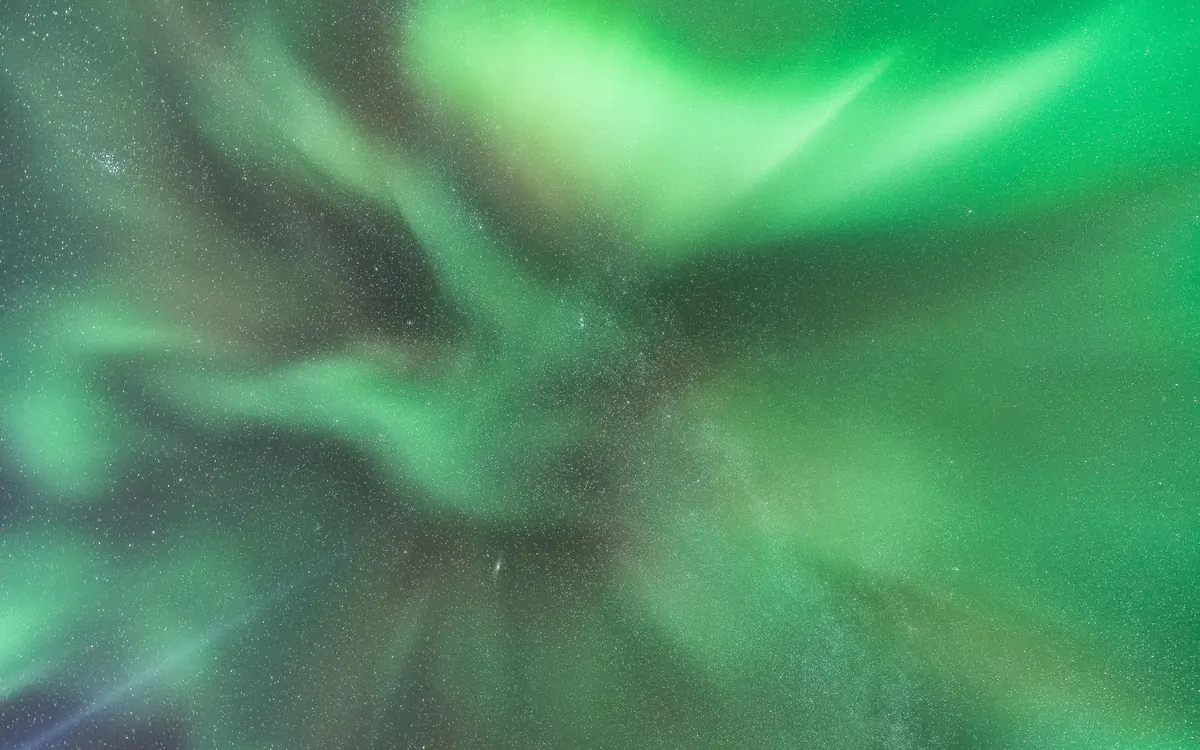
Photographs of the aurora are not lies, but they are not what you see. A camera on a three-second exposure collects light your eye collects in a fraction of a second, so the greens come out stronger and the purples appear at all.
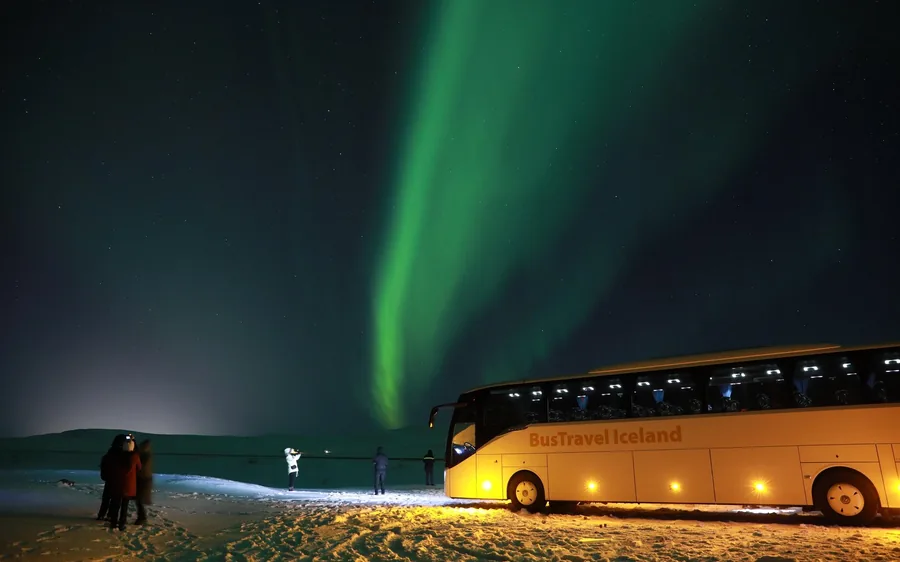
To the eye on an ordinary night: a pale band low to the north, greyish at first, which sharpens into unmistakable green once your eyes have adapted. It moves slowly. It brightens at one end. Somebody points a phone at it and everybody realises it is stronger than it looked.
On a strong night it stops being a band and becomes curtains — vertical structures that ripple along their length, fill half the sky, and move fast enough to follow. That is the night everyone hopes for and it does not come every week.
The single most common reason people say they saw nothing is that they looked for five minutes. Eyes take fifteen to twenty minutes to adapt to the dark, and a phone screen resets the clock.
The numbers, decoded
Six terms you will see on the forecast
- Kp
A 0–9 scale of geomagnetic disturbance. In Iceland, Kp 2 with a clear sky beats Kp 5 under overcast.
- Auroral oval
The ring around the magnetic pole where aurora happens. Iceland is under it, which is the whole point.
- Cloud cover
The number that actually decides your night. Guides look at this first.
- Solar wind speed
How fast the particle stream is arriving. Higher usually means more activity a day or two later.
- Bz
The north–south tilt of the incoming magnetic field. When it points south, the aurora responds. Guides watch it; you do not have to.
- Substorm
A sudden brightening that can last minutes. It is why patience beats forecasting.
The forecast is two numbers, and cloud is the one that matters.
Reading the forecast→Every trip, current fare
Tours that hunt it
Nine ways to get under a clear piece of sky.
| Tour | Time out | Price | Group size | Cost per hour | Rating |
|---|---|---|---|---|---|
| Northern Lights Bus TourThe classic coach hunt, cheapest seat | 4 h | $71 | Coach, up to ~80 | $17.75 | 4.3 · 14,873 |
| Premium Small-Group TourSmall group, flexible route | 4 h | $94 | Small group | $23.50 | 4.4 · 3,126 |
| Northern Lights Minibus TourMinibus with hot cocoa and photos | 4 h | $157 | Small group | $39.25 | 4.6 · 722 |
| Tour with a Pro PhotographerA photographer travels with you | 4 h | $155 | Small group | $38.75 | 4.8 · 446 |
| Northern Lights Yacht TourOut of the harbour by sea | 2 h | $91 | Boat | $45.50 | 4.4 · 1,342 |
| Super Jeep Northern Lights TourOff the road, into the dark | 4 h | $196 | Super jeep, small | $49.00 | 4.2 · 157 |
| Lava Tunnel & Northern LightsLava tunnel first, aurora after | 4 h | $196 | Small group | $49.00 | 4.7 · 80 |
| Whale Watching & Lights ComboWhales by day, aurora by night | 6 h | $190 | Boat | $31.67 | 4.3 · 131 |
| Golden Circle, Blue Lagoon & LightsGolden Circle, Blue Lagoon and the aurora | 15 h | $319 | Coach | $21.27 | 4.7 · 261 |
Myths worth dropping
Four things people believe that are not true
“It has to be freezing.” Temperature has nothing to do with it. Clear nights in Iceland are often cold, which is where the idea comes from.
“You need a big solar storm.” Not in Iceland. Under the auroral oval a quiet night with an open sky produces a perfectly good display.
“A full moon ruins it.” It washes out a weak display and barely touches a strong one. Guides do not cancel for the moon.
“You can hear it.” Reports exist and the physics is disputed. Do not plan your evening around it.
Common questions
Aurora borealis, answered
What causes the northern lights?
Charged particles from the sun are funnelled towards the poles by the Earth’s magnetic field and collide with atoms in the upper atmosphere, which then release that energy as light.
Why is the aurora green?
Green comes from oxygen at around a hundred kilometres, and it is the colour the human eye picks up most easily. Red and purple need stronger activity and usually show up only in photographs.
Do I need a strong solar storm to see it in Iceland?
No. Iceland sits under the auroral oval, so modest activity is enough. Cloud cover matters far more than the Kp number.
Can you see the aurora from Reykjavik itself?
On an active night, from dark spots like Grótta lighthouse. The city glare washes out anything weak, which is why tours drive an hour out.
What time of night is best?
The hours around local midnight, roughly ten to one. That is why almost every tour leaves at nine and returns after twelve.
Why did I see less than in the photographs?
A camera on a long exposure collects far more light than your eye does. The display in the photograph is real; it simply looked paler in person.
Go deeper
More on the aurora in Reykjavik
Northern lights tours from Reykjavik
Every tour that leaves the capital, and how they actually differ.
PricesWhat a northern lights tour costs
Twelve tours priced per person and per hour, with what the listing leaves out.
VerdictThe best northern lights tour
Twelve tours ranked for one decision, with a straight answer at the end.
By coachNorthern lights bus tours
The cheapest way out of the city glare, and its one real limitation.
Super jeepSuper jeep aurora tours
Off the road and away from the coach parks. Worth the money or not.
By boatNorthern lights boat tours
Two hours out of the old harbour, and why the sea has an advantage.