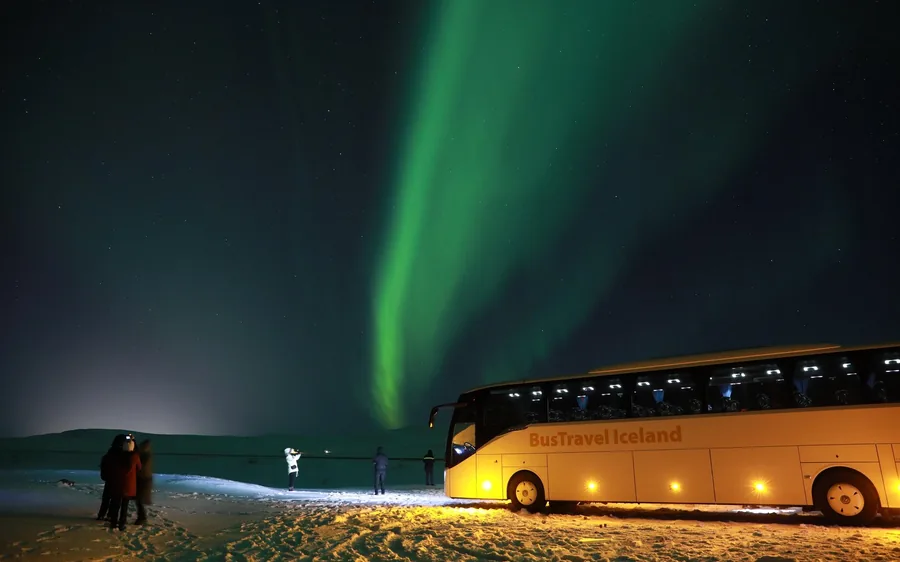
Sep – Oct
The sweet spot
Nights long enough to use, mild enough weather, roads open everywhere, and geomagnetic activity peaking near the autumn equinox. The best combination of the year.
When to come
The best time to see the northern lights in Iceland is September to October or February to March. Activity peaks near the equinoxes, the nights are long enough to use, and the weather is less violent than midwinter. From mid-April to late August there is not enough darkness and the tours simply stop running.
Quick answer
The short answer. Come in late September, October, February or March. Book an aurora tour for the first night of your stay, from $71, and keep at least one more night in reserve. November to January has the darkest skies and the worst weather; mid-April to late August has no night at all and no tours.
Month by month
The score is the chance of a tour running and the sky being usable, not the weather forecast.
Sep – Oct
Nights long enough to use, mild enough weather, roads open everywhere, and geomagnetic activity peaking near the autumn equinox. The best combination of the year.
Feb – Mar
The same equinox effect with more settled weather than midwinter, and enough daylight returning to do something with the day.
Nov – Jan
Up to nineteen hours of darkness and the strongest displays of the year — when the sky is open. It often is not, and storms cancel tours outright.
Apr – Aug
From mid-April the sky never goes properly dark and the tours stop. In June there is no night at all.
Why the equinoxes
Slightly better activity, plus far better odds of a usable night.
Geomagnetic activity is measurably higher around the spring and autumn equinoxes. The usual explanation is that the Earth’s magnetic field is tilted more favourably towards the incoming solar wind at those times of year, which lets more energy in.
The effect is real and it is modest. It does not mean October guarantees anything or that December is a waste of time. What tips the balance in practice is the combination: around the equinoxes you get slightly better activity, genuinely dark nights, and weather that has not yet turned violent.
Midwinter has the darkness and often the best displays. It also has the highest chance that your tour is cancelled for three nights running because a storm is sitting over the country.
How many nights to allow
One night in Iceland is a coin toss and no amount of money changes that. Two nights is a reasonable bet. Three is a good one. Beyond that the returns flatten out.
The reason to think in nights rather than in tours is the free repeat. Almost every operator here rebooks you at no cost if the aurora does not appear, so a ticket bought on your first night is effectively a ticket for every remaining night of your stay.
Bought on your last night, it is one attempt at full price.
This is the cheapest thing you can do to improve your odds and it costs nothing at all: book early in the trip, not late.
Planning around it
Then the free repeat covers the rest of your stay.
Three if the aurora is the reason for the trip.
A quiet aurora under clear sky beats a strong one under overcast.
It washes out a weak display and barely affects a strong one.
Especially November to January. You are refunded.
From mid-April to late August there is no darkness and no tours.
The forecast is two numbers, and only one of them really matters.
Reading the forecast→Every trip, current fare
Everything that runs, and what each one is.
| Tour | Time out | Price | Group size | Cost per hour | Rating |
|---|---|---|---|---|---|
| Northern Lights Bus TourThe classic coach hunt, cheapest seat | 4 h | $71 | Coach, up to ~80 | $17.75 | 4.3 · 14,873 |
| Premium Small-Group TourSmall group, flexible route | 4 h | $94 | Small group | $23.50 | 4.4 · 3,126 |
| Northern Lights Minibus TourMinibus with hot cocoa and photos | 4 h | $157 | Small group | $39.25 | 4.6 · 722 |
| Tour with a Pro PhotographerA photographer travels with you | 4 h | $155 | Small group | $38.75 | 4.8 · 446 |
| Northern Lights Yacht TourOut of the harbour by sea | 2 h | $91 | Boat | $45.50 | 4.4 · 1,342 |
| Super Jeep Northern Lights TourOff the road, into the dark | 4 h | $196 | Super jeep, small | $49.00 | 4.2 · 157 |
| Lava Tunnel & Northern LightsLava tunnel first, aurora after | 4 h | $196 | Small group | $49.00 | 4.7 · 80 |
| Whale Watching & Lights ComboWhales by day, aurora by night | 6 h | $190 | Boat | $31.67 | 4.3 · 131 |
| Golden Circle, Blue Lagoon & LightsGolden Circle, Blue Lagoon and the aurora | 15 h | $319 | Coach | $21.27 | 4.7 · 261 |
Common questions
September, October, February or March. Activity peaks near the equinoxes and the weather is more usable than midwinter.
No. From mid-April to late August the sky never gets dark enough, and the tours stop running entirely.
Two minimum, three if the aurora is the point of the trip. Book the tour on your first night so the free repeat covers the rest.
It has the darkest skies and some of the strongest displays, along with the highest chance of storms cancelling several nights in a row.
The hours around local midnight, roughly ten to one. That is why tours leave at nine.
It washes out a weak display and barely affects a strong one. No operator cancels for the moon.
Go deeper
Every tour that leaves the capital, and how they actually differ.
PricesTwelve tours priced per person and per hour, with what the listing leaves out.
VerdictTwelve tours ranked for one decision, with a straight answer at the end.
The scienceWhat causes it, what the numbers mean, and what you will actually see.
By coachThe cheapest way out of the city glare, and its one real limitation.
Super jeepOff the road and away from the coach parks. Worth the money or not.